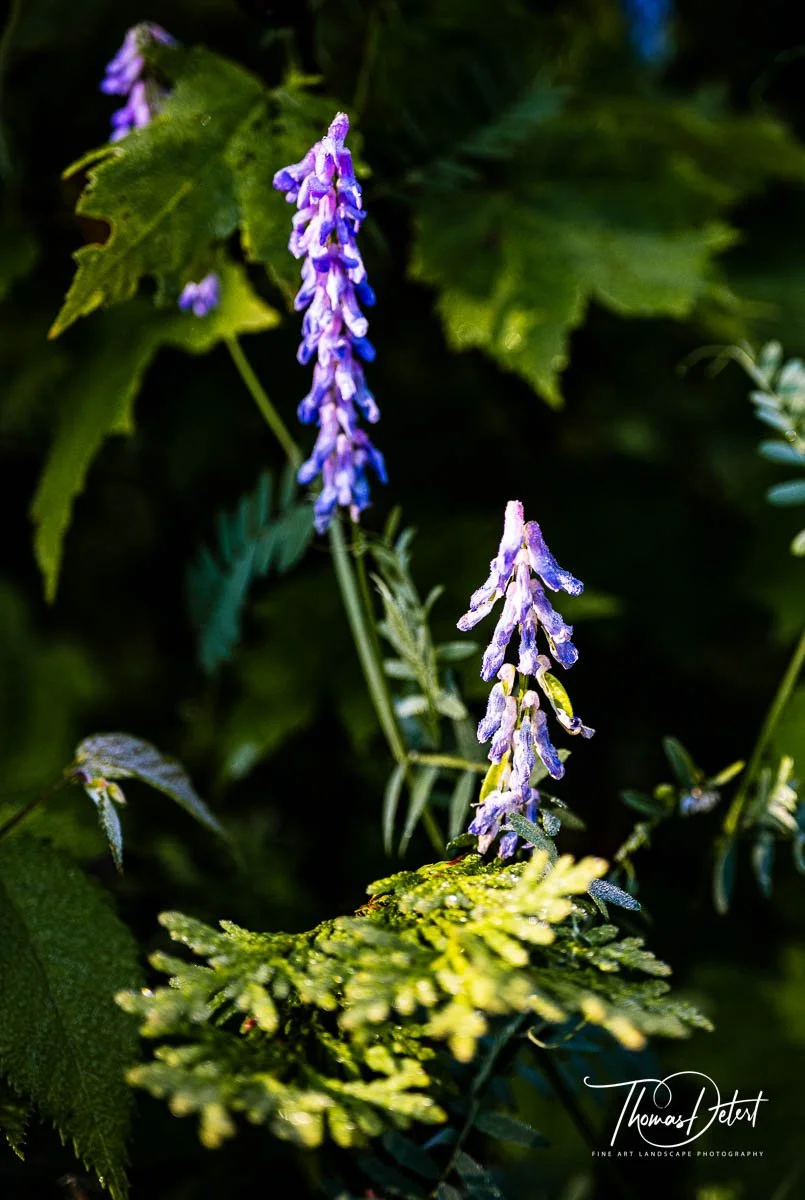
I Risked a Hell Fire of Mosquitoes and Deer Flies for This Photo
A short journal entry about the difficulty of taking a very nice flower photo.
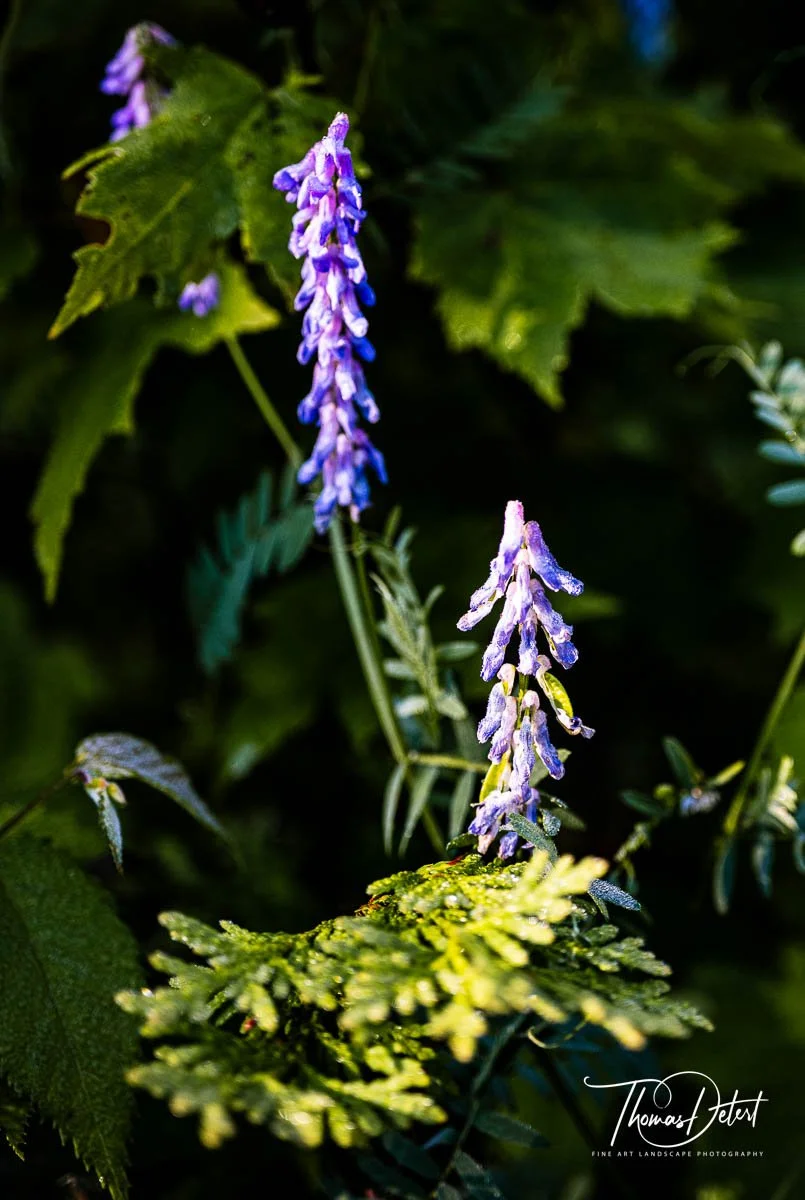
Just a short entry for today…. I grabbed my Nikon Z7ii and 50 mm macro lens (Nikkor 50 mm f/2.8 MC lens) when I took my dog for his morning walk.
The sun was relatively still low in the sky.
Mosquitoes and deer flies were out in full force. To be honest with you, I cannot recall another year any where nearly as bad as they are this year!
I was keeping my eye out for a nicely lit flower.
This scene caught my eye.
I had to work fast or risk requiring a blood transfusion LOL.
If any one knows what those flowers are called, please leave the name in the comment section below. Thanks!

How A New Drug Changed My Life
What if some of what we call weakness is actually biology being pushed too hard by a world designed to keep us consuming? A personal reflection on food noise, life after 50, and learning to think for yourself again.
And Really Got Me Thinking…

by Thomas Detert.
I recently started Zepbound.
I am not writing this as medical advice. I am not writing it as a weight-loss testimonial. And I am certainly not suggesting that any medication is magic.
But I am writing about something that happened after my first injection that I have not been able to stop thinking about.
Within hours, my relationship with food changed.
Not in some dramatic Hollywood way. I did not suddenly become a different person. I did not wake up with a six-pack and a refrigerator full of kale. I did not become morally superior or magically disciplined.
But something got quieter.
The urgency softened. The old background noise around food — the grazing, the craving, the subtle pull toward “just a little more” — was turned down.
And that got my attention.
Because when something changes that quickly, you start asking deeper questions. One of mine was this:
How much of what we call weakness is actually biology being pushed, prodded, overstimulated, and manipulated?
That question has stayed with me.
For years, like many people, I assumed that my relationship with food was mostly a matter of discipline. Eat less. Move more. Make better choices. Stop making excuses. Be stronger.
And yes, personal responsibility matters. It matters a lot.
But after experiencing what it felt like when the food noise dropped, I had to ask myself something uncomfortable:
What if I had been blaming myself for fighting a battle that had been engineered to be harder than it needed to be?
Food Is Not Just Food Anymore
We live in a world where food is everywhere.
It is cheap, convenient, colourful, salty, sweet, crunchy, creamy, portable, and available at almost any hour of the day. But more than that, a lot of modern processed food is designed to be extremely easy to overeat.
That is not an accident.
Food companies do not make more money when we feel satisfied and stop eating. They make more money when we keep buying, keep snacking, keep reaching, keep craving, and keep coming back.
I am not saying every processed food is poison. I am not saying every person who works in the food industry is evil. That would be too simplistic, and frankly, not very useful.
But I am saying the incentives are obvious.
If a company profits when I consume more, then my satiety is not necessarily their priority. My health is not their business model. My peace around food is not their quarterly target.
The goal is not always nourishment. Sometimes the goal is repeat consumption.
That means taste, texture, packaging, convenience, marketing, portion size, and emotional association all matter. The crunch matters. The sweetness matters. The salt matters. The mouthfeel matters. The way the food disappears quickly without making you feel truly full matters.
And if you have ever opened a bag of something intending to eat a small amount, only to look down a few minutes later and wonder where the rest of it went, you know exactly what I am talking about.
It is not always hunger.
Sometimes it is design.
Maybe We Are Not as Weak as We Think
This is the part that has made me more compassionate toward myself.
After that first Zepbound injection, I did not feel like a heroic man of iron will. I felt like a man who had been given a brief glimpse of what life feels like when one particular volume knob gets turned down.
And honestly, it was humbling.
Because it made me wonder how many people are walking around believing they are lazy, weak, undisciplined, broken, or morally flawed when in reality they are living inside an environment that has been designed to hijack some of the most primitive parts of the human brain.
Food is emotional. Food is biological. Food is social. Food is cultural. Food is memory, comfort, reward, habit, and chemistry.
So when powerful industries learn how to push those buttons better and better, maybe we should stop pretending this is only about willpower.
Willpower matters.
But willpower was never meant to be the only defence against an entire environment designed to overwhelm it.
That does not mean we are helpless. But it does mean we need to be honest.
After 50, the Game Changes
This topic hits differently for me now than it would have at 25, 35, or even 45.
Because after 50, the body changes.
That is not defeatist. It is reality.
The metabolism is different. Muscle is harder to maintain. Recovery takes longer. Testosterone is often lower than it once was. Sleep may not be as forgiving. Stress seems to leave a deeper footprint. The “get up and go” that used to appear automatically sometimes needs to be deliberately cultivated.
And the body becomes less tolerant of nonsense.
When I was younger, I could get away with more. Bad food, poor sleep, stress, inconsistency — I could often push through it. I might not have felt great, but I could still function.
Youth gives you a buffer. It lets you borrow from the future and pretend the bill will never arrive.
But after 50, the bill starts showing up.
Not all at once. Not necessarily in some dramatic crisis. But in subtle ways.
Less energy. More stiffness. More belly fat. Less resilience. Poorer sleep. More brain fog. Lower mood. Reduced confidence. Less desire to move. More temptation to numb out. More reliance on comfort.
And this is where the manipulation of food becomes especially important.
Because the very stage of life where we most need nourishment, strength, stability, protein, movement, sleep, and self-respect is the same stage where the modern food environment is still trying to sell us cheap stimulation.
It does not care that we are 50.
It does not care that our blood sugar matters. It does not care that our joints matter. It does not care that our testosterone, muscle mass, heart health, waistline, mood, and mental clarity matter.
It does not care that we want to feel alive for the next chapter.
It just wants us to keep consuming.
And if we are tired, stressed, lonely, discouraged, or quietly disappointed with where life has landed, we become even easier to reach.
That is not a character flaw.
That is a vulnerable human being living inside a very sophisticated environment.
Life After 50 Is Not the Leftover Portion
This is one of the reasons I think so much about life after 50.
Because life after 50 is not just about aging. It is about awakening.
It is about realizing that the old operating system may no longer work. The habits that got us here may not get us through the next chapter. The foods we tolerated may no longer serve us. The stress we normalized may now be costing us. The distractions we used to call entertainment may now be stealing the quiet we need to hear ourselves think.
And the dreams we postponed do not disappear just because we got older.
They wait.
Sometimes quietly. Sometimes painfully. Sometimes under layers of fatigue, regret, responsibility, and “maybe it’s too late.”
But I do not believe it is too late.
I believe life after 50 can become one of the most honest, powerful, and meaningful seasons of a person’s life — if we are willing to stop sleepwalking.
At this stage, health is not vanity. It is access.
Access to energy. Access to purpose. Access to confidence. Access to freedom. Access to joy.
And maybe that is why this topic matters so much to me. Because this is not just about losing weight or eating better. It is about asking whether the way we are living is actually supporting the person we still want to become.
This Goes Beyond Food
Food may be the easiest place to see it, but I do not think it stops there.
Once you start noticing how our biology can be manipulated through food, you begin to notice the same pattern elsewhere.
Our attention is manipulated. Our fear is manipulated. Our insecurity is manipulated. Our loneliness is manipulated. Our outrage is manipulated. Our desire to belong is manipulated. Our desire to be admired is manipulated.
And again, manipulation is not new.
The powerful have always tried to shape the behaviour of the many. Kings did it. Empires did it. Religions did it. Governments did it. Advertisers did it. Newspapers did it. Television did it.
What feels different now is the precision, the intimacy, and the saturation.
The manipulation follows us into our homes, our phones, our pockets, our bedrooms, our news feeds, our search results, our grocery carts, our streaming platforms, and our sense of identity.
It is no longer just a billboard on the side of the road.
It is the algorithm learning when you are tired. It is the ad that finds you when you are lonely. It is the influencer who makes you feel inadequate while selling you the solution. It is the celebrity who pretends to be authentic while promoting something they were paid to endorse.
It is the food product that lights up your senses while leaving your body undernourished.
It is the constant message that you are not enough yet — but you could be, if only you bought the next thing.
This is not paranoia.
This is pattern recognition.
The Danger of Outsourcing Your Thinking
One of the great risks of modern life is that we outsource too much of our thinking.
We follow influencers. We trust celebrities. We repeat headlines. We assume popularity equals credibility. We confuse confidence with wisdom. We mistake visibility for authority.
And I get it.
We are busy. We are tired. There is too much information. It is tempting to let someone else do the thinking for us.
But that is dangerous.
Because not everyone who has your attention has your best interest at heart.
Some people want to help you. Some people want to sell to you. Some people want to influence you. Some people want to keep you angry. Some people want to keep you afraid. Some people want to keep you dependent.
And some people want to keep you hungry — literally and metaphorically.
The more we outsource our discernment, the easier we are to lead.
That does not mean we should trust no one. It means we need to rebuild the habit of thinking for ourselves.
Research. Question. Compare sources. Pay attention to incentives. Ask who benefits. Ask what is being left out.
Ask whether the person speaking has actually lived what they are teaching. Ask whether they are trying to make you more free, or more dependent on them.
That one matters.
Personal Growth Is Not Optional Anymore
I used to think personal growth was something you pursued if you wanted a better life.
Now I think it is also a form of self-defence.
Not in an aggressive way. In a grounded way.
The more you know yourself, the harder you are to manipulate. The more emotionally regulated you are, the harder it is to control you through fear. The more secure you are, the harder it is to sell to your insecurity.
The more connected you are to your values, the harder it is to distract you with noise.
The more physically healthy you become, the harder it is to normalize feeling terrible.
The more you learn to pause, the harder it is to push you into impulsive decisions.
That is why personal development matters.
Not the cheesy version. Not the motivational poster version. Not the “wake up at 4 a.m. and dominate everyone” version.
I mean the real version.
The quiet version.
The version where you take responsibility for your life. The version where you become more aware of your habits, emotions, cravings, beliefs, fears, and patterns. The version where you stop sleepwalking through your own existence.
The version where you begin asking better questions.
Why do I want this?
Where did this belief come from?
Is this actually good for me?
Am I choosing this, or am I being nudged?
Does this make me more alive, or just more stimulated?
Does this serve the person I am trying to become?
That kind of growth is not fluffy.
It is freedom work.
The Hope
I do not want to end this in anger.
Anger has its place. It can wake us up. But if we stay there too long, it becomes just another form of manipulation.
I also do not want to end in cynicism. Cynicism feels intelligent for a while, but eventually it becomes lazy. It says, “Everything is corrupt, so why bother?”
I do not believe that.
I believe we bother because our lives still matter.
Our health matters. Our minds matter. Our families matter. Our communities matter. Our joy matters. Our ability to think clearly matters. Our ability to choose consciously matters.
And maybe that is where we begin.
Not by trying to overthrow the entire machine in one dramatic gesture. But by waking up in small, deliberate ways.
Read labels. Eat food that loves you back. Notice what makes you feel compulsive. Notice what makes you feel calm. Turn off the noise more often.
Spend time outside. Move your body. Question the people who profit from your insecurity.
Stop worshipping influencers just because they are popular. Stop assuming celebrities know more than you do about how to live. Do your own research. Make your own decisions. Build your own discernment.
And most importantly, learn to trust yourself again.
Because that may be the deepest damage manipulation does.
It does not just get us to buy the product. It gets us to doubt our own inner authority.
It makes us believe we are weak when we are overwhelmed. It makes us believe we are broken when we are overstimulated. It makes us believe we need someone else to tell us who to be, what to want, what to fear, what to eat, what to buy, and how to live.
But we can come back from that.
Maybe this is one of the gifts of life after 50.
We may not have the same metabolism we had at 25. We may not have the same testosterone, recovery, or automatic get up and go. We may not be able to abuse our bodies and bounce back as quickly as we once did.
But we do have something else.
We have perspective.
We have lived enough life to recognize patterns. We have made enough mistakes to know that not every craving deserves obedience. We have survived enough disappointment to know that numbness is not peace. We have chased enough things to know that stimulation is not the same as joy.
And maybe, if we are willing, we can become harder to manipulate.
Not bitter. Not paranoid. Not cynical.
Just awake.
Grounded.
Curious.
Self-respecting.
Willing to research.
Willing to question.
Willing to make our own decisions rather than blindly following influencers, celebrities, algorithms, headlines, or corporations that profit from our confusion.
That is where hope lives for me.
Not in pretending the world is not manipulative. Not in pretending aging is not real. Not in pretending discipline alone solves everything.
Hope lives in the decision to wake up and participate in our own lives again.
To eat in a way that supports the person we still want to become. To move because we are grateful we still can. To protect our attention because our remaining years matter. To question what we are being sold.
To choose growth over resignation.
To stop outsourcing our wisdom.
To remember that life after 50 is not the leftover portion.
It may be the most honest chapter yet.
My first Zepbound injection did not answer all of life’s questions.
But it gave me one powerful insight:
Sometimes the noise we think is ours was never really ours.
And once you realize that, you can start turning it down.
One meal. One walk. One honest question. One better decision. One reclaimed piece of yourself at a time.

Human Potential… And Why You Likely Haven’t Achieved Yours… YET!
By midlife, most men have learned how to function — how to endure, provide, and keep going. What often gets lost along the way is depth, presence, and the quiet sense of aliveness that once guided them. This long-form reflection explores why human potential so often goes unrealized — and why life after 50 may be the moment it finally has room to emerge.

Image courtesy of Adobe Firefly
by Thomas Detert — Certified High Performance Coach.
First off, I’d like to apologize for the title, and the image I have chosen for this post. But it was necessary. I know it feels a bit jarring, and perhaps more than a little “off-brand”. But that was the point. I had to get your attention.
There is a particular kind of quiet that only shows up later in life.
It’s not the quiet of peace.
And it’s not the quiet of despair.
It’s the quiet that comes when the noise dies down just enough for a deeper question to be heard.
It often arrives when the house is empty.
When the fire has burned low.
When the work is done for the day and there’s nothing left to distract you.
And in that quiet, something inside asks — gently, almost apologetically:
Is this really all I was meant to do with this life?
Not in terms of achievement.
Not in terms of income or recognition.
But in terms of aliveness.
The skill of functioning
By the time a man reaches his fifties, he has learned how to function.
This is no small thing.
He has learned how to regulate emotion enough to stay employed.
How to keep commitments.
How to endure.
How to carry responsibility without complaint.
He knows how to show up even when he doesn’t feel like it.
How to keep going even when something inside him is tired in a way sleep doesn’t fix.
Functioning is a skill — and it is rewarded.
But functioning is not the same as living.
And somewhere along the way, many of us stopped noticing the difference.
When survival quietly replaces meaning
In earlier years, life had an exploratory quality to it.
There were questions we asked without realizing we were asking them:
Who am I?
What matters?
What kind of man am I becoming?
Over time, those questions are slowly crowded out.
Not by catastrophe.
By accumulation.
Bills.
Schedules.
Expectations.
Roles we never consciously auditioned for, but learned to play well.
Eventually, survival becomes the organizing principle.
And survival, left unchecked, has a way of shrinking the soul.
Not dramatically.
Incrementally.
Until one day you realize you’ve become very good at maintaining a life…
and less practiced at inhabiting it.
The modern condition: constant stimulation, diminished depth
We live in an age that promises connection and delivers fragmentation.
The phone in your pocket is not neutral.
It is a machine designed to pull attention outward, keep the nervous system activated, and reward the brain with small, frequent doses of stimulation.
Not enough to satisfy.
Just enough to keep you reaching.
Over time, this does something subtle but profound.
It erodes the ability to sit with discomfort.
It weakens memory and reflection.
It makes silence feel unfamiliar — even threatening.
Some call this digital dementia, but the phrase doesn’t go far enough.
What we’re really losing is depth.
Depth of thought.
Depth of feeling.
Depth of presence.
A man who never sits with his own mind long enough to hear it cannot know himself — no matter how busy or informed he is.
The anesthetics we normalize
When dissatisfaction appears, we rarely greet it with curiosity.
We treat it like an interruption.
So we soften it.
With alcohol in the evening.
With noise in the background.
With endless information we’ll never integrate.
None of this makes us bad or weak.
It makes us tired.
And exhaustion has a way of convincing us that numbness is peace.
But dissatisfaction is not a malfunction.
It is a signal.
A sign that something essential has been deferred too long.
A quieter truth about human potential
When we talk about potential, we often imagine unrealized success.
More money.
More freedom.
More accomplishment.
But human potential, at its core, is not about accumulation.
It is about expression.
It is the capacity to live in alignment with what we value.
To act deliberately rather than reactively.
To be present rather than perpetually elsewhere.
Potential is not something you reach.
It is something you allow.
And allowance requires space — mental, emotional, and spiritual.
Space most of us have not protected.
A personal reckoning
There came a point in my own life when I had to admit something uncomfortable.
I was doing many of the right things.
I was competent. Responsible. Productive.
And yet, I felt slightly removed from my own life.
As though I was standing beside it rather than inside it.
Not depressed.
Not broken.
Just under-expressed.
That realization doesn’t arrive with urgency.
It arrives with clarity.
And clarity has a way of asking for honesty.
Power looks different later in life
In youth, power often looks like momentum.
Later in life, power looks like coherence.
It is the ability to move through the world without constantly betraying yourself.
To let your actions reflect your values.
To let your time reflect what matters.
To let your nervous system settle enough to think clearly again.
Men who reclaim this kind of power do not become louder.
They become steadier.
They listen more.
React less.
Choose deliberately.
And the people around them feel it — not because it’s announced, but because it’s embodied.
Why most men never truly try
Trying, at this stage of life, is not about effort.
You’ve already proven your capacity for effort.
Trying now means telling the truth — first to yourself.
It means questioning assumptions you’ve lived inside for decades.
Letting go of identities that once served you but no longer fit.
Allowing the future to look different from the past.
Most men don’t avoid this because they lack courage.
They avoid it because familiarity feels safe — even when it’s draining.
The invitation of the second half
Life after 50 is not a winding down.
It is a narrowing.
A narrowing toward what is essential.
This phase of life does not ask for reinvention.
It asks for attention.
Attention to what you’ve been postponing.
Attention to what still wants expression.
Attention to the life that remains — which is far from insignificant.
Human potential does not expire.
If anything, it matures.
A different way forward
The path forward does not require escape.
It requires presence.
Less stimulation.
More stillness.
Fewer distractions that dull the senses.
It requires the courage to sit quietly long enough to hear what your life has been asking of you.
Not dramatically.
Persistently.
The question worth carrying
So here is the question I would invite you to carry with you — not to answer quickly, but to live into:
If you chose to fully inhabit the rest of your life — with honesty, presence, and intention — what would need to change first?
You already know.
And that knowing is not a burden.
It is a beginning.
Out here, there is room
Out here — away from the noise, the pace, the endless stimulation — there is room to remember who you are.
Room to breathe.
Room to reflect.
Room to live deliberately again.
Human potential is not something behind you.
It is something waiting — patiently — for your attention.
…yet.
An Invitation
If this topic and this post have rekindled a yearning and curiosity about your own future, and potential.. I invite you to request a free conversation with me to explore how we might work together to help you lean into that untapped potential. Just fill out the form below. You future is waiting.
When a Life That’s Working No Longer Fits
Sometimes nothing is broken — and yet something no longer fits. This reflection explores the quiet moment when a life that still works begins asking deeper questions, and why honesty, not urgency, is often what carries us forward.
by Thomas Detert
Most people expect life to tell them—loudly—when something needs to change.
They imagine a breaking point.
A crisis.
A failure.
Some unmistakable sign that it’s time to start over.
But for many of us, especially later in life, it doesn’t happen that way.
Sometimes the problem is quieter.
Your life still works.
The bills are paid.
The structure is intact.
From the outside, nothing appears wrong.
And yet… something feels off.
Not broken.
Not dramatic.
Just misaligned.
The Strange Discomfort of a Life That Functions
There’s a particular discomfort that comes with realizing you’ve outgrown a life that still functions.
It’s not dissatisfaction in the usual sense.
It’s more like contraction.
You notice you’ve become:
more careful
more contained
less expressive
less curious
You still show up.
You still do what’s required.
But the energy that once carried you forward now goes into maintaining rather than becoming.
And that can be harder to name than outright misery.
Because how do you justify wanting change when nothing is technically “wrong”?
Stability Isn’t the Same as Alignment
Stability has a powerful moral story attached to it.
We’re taught that if something is working, we should be grateful.
That wanting more is indulgent.
That questioning a solid life is a kind of failure of character.
But stability and alignment are not the same thing.
A life can be stable and still quietly demand that you shrink.
It can be safe and still require silence.
It can be successful and still prevent growth.
At some point, the question shifts from:
“Is this life good enough?”
to something more honest:
“What is this life asking me to give up in order to stay?”
The Moment You Can’t Unsee
There’s often a moment—small, unannounced—when this becomes clear.
You’re alone.
There’s no audience.
No drama.
And the thought arises:
“I could keep doing this… but I don’t think I can keep becoming myself while I do.”
Once that thought appears, it doesn’t go away.
You can postpone it.
You can reason with it.
You can stay busy.
But something inside you has already noticed the truth.
Why Courage Rarely Comes First
We talk a lot about courage, but courage is rarely the first thing to arrive.
Clarity comes first.
Clarity about what no longer fits.
Clarity about what feels heavy instead of life-giving.
Clarity about the cost of staying exactly as you are.
Only after that does courage appear—and when it does, it’s quieter than expected.
Not dramatic.
Not reckless.
Just steady.
A Different Kind of Risk
Later in life, the risk isn’t always leaving.
Often, the greater risk is staying too long—
not because staying is wrong,
but because it slowly teaches you to stop listening to yourself.
The danger isn’t failure.
It’s numbness.
It’s waking up one day and realizing you traded too much of your inner life for certainty.
A Closing Thought
If this resonates, it doesn’t mean you need to burn anything down.
It doesn’t mean drastic moves or sudden reinvention.
It simply means you’re at a point where honesty is asking to be heard.
And honesty doesn’t demand action right away.
It asks for attention.
Sometimes the most meaningful change begins not with a decision—but with the willingness to stop pretending that a life which merely works is enough.

Quitting Alcohol Opened My Eyes…
Quitting alcohol didn’t happen because everything fell apart. It happened because I finally noticed what numbing was costing me. This is a first-person reflection on clarity, discomfort, and what becomes possible when you stop muting the signals that are trying to guide you forward.

Image courtesy of Adobe Stock
by Thomas Detert.
Alcohol Didn’t Ruin My Life. It Just Paused It.
Alcohol didn’t ruin my life.
It just made me tolerate one I should have outgrown.
Nothing was “wrong” with my drinking.
That was the problem.
For a long time, alcohol felt like a companion.
Not a problem.
Not a crisis.
Just… there.
It helped take the edge off the day. It softened stress. It blurred dissatisfaction just enough that I could keep going without asking hard questions.
And that’s exactly why it stayed.
Alcohol has a way of numbing things quietly. Not just pain, but the signals — the internal nudges that say, Something here needs to change.
Discomfort.
Restlessness.
That low hum of dissatisfaction you feel when a life no longer fits quite right.
Those signals aren’t flaws. They’re messages.
Alcohol doesn’t erase them. It just turns the volume down.
I’ve quit drinking before. More than once.
And I’ve restarted too — telling myself I was fine, that I had perspective now, that this time would be different.
I wasn’t reckless. I wasn’t falling apart. I was functioning. Productive. Responsible. From the outside, nothing looked “wrong.”
But inside, something was stalled.
What I eventually realized is that alcohol wasn’t wrecking my life.
It was pausing it.
When I’m honest with myself, alcohol allowed me to tolerate things I shouldn’t have.
Drift.
Avoidance.
Decisions I knew I needed to make — but didn’t.
It made it easier to sit with misalignment instead of confronting it. Easier to stay comfortable instead of decisive. Easier to postpone change and call it patience.
Nothing dramatic happened.
No crash. No collapse.
Just a slow accumulation of later.
And later can quietly turn into years.
This time, I stopped for good.
Not because of guilt.
Not because of fear.
Not because I hit some mythical bottom.
I stopped because I finally noticed the contrast.
Without alcohol, I’m clearer.
My thinking is sharper. My energy is steadier. My motivation feels intrinsic again — not forced or borrowed from caffeine and momentum.
But more than that, I’m present.
Present enough to sit with discomfort instead of escaping it. Present enough to listen to myself. Present enough to act.
I’m no longer circling the things I know need attention — in my work, my habits, my direction. I’m addressing them.
Quietly. Honestly. One decision at a time.
What alcohol really took from me wasn’t health or reputation.
It took authorship.
It took my willingness to stay with discomfort long enough for it to show me something true.
Now the signals are back.
And I welcome them.
Because discomfort, when you stop numbing it, turns into clarity.
And clarity, sooner or later, demands action.
I didn’t quit drinking to become better.
I quit to become myself again.
More awake.
More deliberate.
More honest about what isn’t working — and more willing to change it.
This isn’t an argument against alcohol.
It’s a reflection on what happens when you stop muting the voice inside you that knows it’s time to live differently.
There’s no pitch here.
No lesson.
No prescription.
If this resonated, my hope isn’t that you agree with me — or even that you stop drinking.
My hope is that you pause long enough to notice where you might be numbing something that deserves your attention.
And that you choose your own next step.
For me, one book that helped reframe this journey was CLEAR: The Only Neuroscience-Based Method for High Achievers to Quit Drinking Without Willpower, Rehab or AA. Not because it told me what to do — but because it helped me see what was already true.

The Subtleties of Fairness After 50
There was no breaking point—just a quiet afternoon, a warm mug of chai, and the sudden realization that I hadn’t been unfair to anyone else. I’d been unfair to myself. This is a story about balance, solitude, and the quieter kind of freedom that comes from finally being fair as life shifts after 50.

Image courtesy of Adobe Stock.
The Day I Realized I’d Been Unfair
I don’t remember the exact day it happened, which somehow feels fitting.
There was no argument. No breaking point. No dramatic moment where everything finally made sense. Just an ordinary afternoon that should have felt peaceful and didn’t.
I was sitting at the table with a warm mug cradled between my hands — a soothing cup of spicy chai, the kind that carries hints of cinnamon and cardamom and asks you to slow down. Outside, the trees moved gently in a breeze that didn’t demand attention. Everything out there seemed settled, unhurried.
Inside, I wasn’t.
At first, I told myself I was simply tired. That this was what life felt like after 50, or close to it. You live alone. You take responsibility for yourself. You grow used to the quiet. You stop expecting life to surprise you.
But the tiredness felt different. It wasn’t the kind that comes from a long day or a poor night’s sleep. It felt deeper — like something had been thinning out over time.
And then, in that quiet, a thought surfaced that caught me off guard:
I hadn’t been unfair to anyone else.
I had been unfair to myself.
That idea stayed with me longer than I expected.
I’d always thought of myself as reasonable. Fair. The kind of person who tried not to take up too much space. I listened. I adjusted. I made room. I believed that was maturity — especially as you get older and learn that not everything needs to be said.
For a long time, I wore that as a quiet point of pride.
But looking back now, I can see how often fairness quietly became endurance.
I said yes when a pause might have served me better.
I stayed silent when something didn’t feel quite right.
I absorbed inconvenience because it felt easier than explaining myself.
None of it felt dramatic in the moment. That’s what makes it hard to see while you’re in it. These aren’t decisions you make once — they’re habits you slip into.
I remember one evening in particular, years ago now. The day had been long in that familiar way — nothing terrible, nothing inspiring. Someone asked for just one more thing. Nothing unreasonable. Nothing I couldn’t do.
I agreed, automatically.
But as I did, I felt a quiet tightening inside me. Not anger. Not resentment. Just a small sense that I’d stepped a little further away from myself without meaning to.
That feeling followed me home.
What stayed with me wasn’t the request. It was how little space I’d given myself to consider whether it was fair — not in theory, but in practice. Fair to my energy. Fair to where I was in my life at that moment.
I began to notice how often I defaulted to being “the reasonable one.” How easily I carried weight that no one had explicitly handed me. How often I told myself that my needs could wait — again.
And slowly, I started to notice the cost.
Energy didn’t return the way it used to.
Evenings felt flatter.
Decisions carried more weight than they should have.
Nothing was falling apart. But nothing felt fully alive either.
It took me time to understand that fairness, as I’d been practicing it, wasn’t balanced. It leaned heavily toward keeping things smooth in the moment, even if that meant quietly setting myself aside.
The shift didn’t come from a bold decision. It came from gentler questions.
What would be fair here — not just for them, but for me?
If I keep responding this way, where does it lead?
How long am I willing to live with this version of “reasonable”?
Those questions didn’t demand immediate answers. They simply asked me to pay attention.
And in paying attention, something softened.
Not because I started saying no to everything.
Not because I stopped caring.
But because I began to care about balance.
Living alone — or on the brink of that reality — has a way of making imbalance more obvious. There’s no one else to absorb the overflow. No distraction from what doesn’t sit right. Quiet has a way of amplifying truth.
Out here, close to nature, that truth feels simpler. The lake doesn’t overextend itself. The seasons don’t apologize for changing. Nothing explains itself or asks permission.
Fairness in nature isn’t sentimental. It’s honest.
If I could speak to my younger self now — or to someone standing on the edge of this stage of life — I wouldn’t tell them to be tougher or more self-protective.
I’d tell them this:
Being fair doesn’t mean carrying everything.
And it doesn’t mean carrying it alone.
Somewhere along the way, I learned that fairness, practiced gently and honestly, creates a quieter kind of freedom. The kind that lets you exhale. The kind that makes solitude feel spacious rather than heavy.
And maybe that’s what freedom after 50 really is.
Not escape.
But coming back into balance with yourself.

The Man in the Cabin: A Parable About Subtle Manipulation and Finding Your Voice Again
When Eli agrees to help a neighbour for “just a few days,” he’s slowly pulled into a quiet storm of subtle manipulation—requests that aren’t really requests, shifting moods, guilt, pressure, and the slow erosion of his peace. As the tension builds, Eli must learn to trust the one voice he’s ignored for too long: his own. This reflective northern-parable explores boundaries, intuition, and the moment a man finally chooses himself again.

Image courtesy of Adobe Stock.
by Thomas Detert
There was once a man named Eli, who lived in a small cabin deep in the northern woods—simple, quiet, and steady. After years of storms, heartbreak, and rebuilding, he had finally found a life that fit him like a well-worn flannel shirt.
One winter, Eli agreed to help out a neighbour named Grant, who owned a lodge in the next town over. Grant needed “just a hand for a few days.” Eli, being dependable and kind, said yes.
And that’s where the trouble began.
1. The First Shift: When “Requests” Aren’t Really Requests
Eli had barely arrived at the lodge when Grant said:
“Good—you’ll be here for the next two weeks.”
Not could you, not would you, not does this work for you.
Just a declaration.
Eli felt something tighten in his chest, but he brushed it off.
Grant had a way of making everything sound final.
2. The Manufactured Crisis
The next morning, Grant burst into the kitchen pulling on his jacket.
“There’s a group arriving tonight. I need you to stay late. No one else can handle this.”
Eli knew that wasn’t true—Grant had three other staff members on payroll.
But Grant said it with such urgency, such insistence, that Eli simply nodded.
He worked well into the night.
3. Warm Sun, Sudden Storm
The following day, Grant was smiling, slapping Eli on the back, offering him fresh coffee, talking like they were old friends.
But that afternoon, when Eli asked about taking his promised day off, Grant’s face hardened instantly.
“We’ll talk about that later,” he said sharply.
Eli felt as if the conversation had slipped through his hands like cold water.
4. Weaponized Guilt
By the end of the week, Eli finally said:
“I need to go home tomorrow.”
Grant sighed dramatically.
“I thought you were dedicated. Everyone else pushes through. Maybe I misjudged your work ethic.”
Eli felt the weight of those words all night.
Not because they were true—
but because they were crafted to sting.
5. The Rewritten Story
When the two weeks were up, Eli approached Grant about leaving.
“You agreed to stay a month,” Grant said flatly.
“That’s not what I said,” Eli replied.
Grant smiled, as if amused.
“You must be remembering wrong, Eli. You’ve been tired.”
The doubt crept in.
Was he misremembering?
Had the conversation gone differently?
His instincts said no.
His mind was starting to wonder.
6. The “Teamwork” Trap
When Eli finally tried to step back, Grant said:
“We all make sacrifices here. You leaving now puts everyone in a bind.”
But Eli had noticed something:
Grant never sacrificed anything.
Everyone else did.
7. The Body Never Lies
One morning, Eli woke with a deep sense of dread—something he hadn’t felt since the hardest years of his life.
His stomach twisted.
His chest felt heavy.
He struggled to breathe.
He looked at his truck parked outside the cabin window.
The snow on the windshield glowed blue under the early light.
He knew what the feeling meant.
His body was telling him:
“This situation is not good for you.”
The Moment of Clarity
Eli packed his things quietly and walked out before Grant even arrived.
When Grant called later, leaving angry messages, Eli let the phone ring.
He stood by the frozen shoreline outside his cabin, the cold biting the air, the silence steady and honest.
He finally understood:
Manipulation doesn't always show up like a monster.
Sometimes it shows up like a neighbour who wants a ‘simple favour.’
The danger lies in its subtlety.
And freedom begins the moment you recognize the pattern and walk away.
The Real Lesson
This wasn’t just about Grant.
It was about every season of Eli’s life where he’d ignored his intuition, doubted his instincts, or stayed too long in places where he was slowly disappearing.
Standing there by the lake, he made himself a quiet promise:
“I won’t abandon myself again.”
If You Saw Yourself in Eli…
Manipulation doesn’t just drain your energy.
It erodes your confidence, your clarity, and sometimes even your sense of who you are.
If Eli’s story felt familiar…
if you’ve ever ignored your instincts, stayed too long, or felt the slow tightening in your chest when someone crossed a line…
Please know this:
You’re not alone.
And you don’t have to navigate this season by yourself.
If you’d like support, a listening ear, or guidance through your own chapter of change, I’m here.
Reach out anytime for a private, judgment-free coaching conversation.
Sometimes one good conversation is all it takes to start finding your way back home.

The Peace That Comes When You Stop Pretending
At midlife, success stops being about appearances and starts being about peace. Discover the quiet freedom that comes when you let go of pretending and start living authentically.

Image courtesy of Adobe Stock.
by Thomas Detert — Certified High Performance Coach
A Moment of Perspective
I was standing in the coatroom of a downtown hotel in Toronto, attending a continuing education course for dentists.
Nothing unusual about that — a bunch of professionals gathered to learn, trade stories, sip coffee. But something caught my eye: my well-worn Walmart parka hanging beside a row of $1,000 Canada Goose coats.
It made me smile. Not because I judged anyone, but because ten or twenty years ago, I probably would’ve been the guy wondering if I should own one too.
I walked through the lobby, watching luxury cars pull into the underground garage — the quiet ballet of people showing the world how well they’re doing. And I thought:
Are they any happier?
Any more at peace?
Do they feel at home in their own skin?
Because I’ve learned something over time — there’s a difference between living well and looking like you are.
The Illusion of “Having It All Together”
When we’re young, we chase the idea of what success is supposed to look like.
We think it’s measured by the house, the car, the vacations, the brand names.
But life has a way of teaching you otherwise.
You hit a few walls. You lose people you love. You burn out trying to please everyone. And somewhere along the line, you realize that peace doesn’t come from polish.
It comes from presence.
It’s not about how sharp your clothes are — it’s about how still your soul is.
The Weight of Pretending
There’s a quiet exhaustion that comes from pretending.
Pretending you’re okay when you’re not.
Pretending you’re further ahead than you feel.
Pretending you don’t care what anyone thinks — when deep down, you do.
The trouble is, the more you perform, the less you know who you really are. You lose the sound of your own voice under all the noise of trying to keep up.
I know, because I’ve been there — smiling through burnout, holding it all together for the sake of appearances, even when I was running on fumes inside.
It took years — and some hard truth — to realize that the image of success can become a prison if you never stop to ask who you’re doing it for.
The Freedom of Authenticity
These days, I care less about impressing people and more about expressing what’s real.
Real is showing up as yourself, without apology.
Real is saying, “I don’t need to prove anything today.”
Real is buying the coat that keeps you warm — not the one that keeps up appearances.
There’s peace in that. A deep, quiet kind of peace that money can’t buy.
You stop competing and start connecting. You stop worrying about being liked and start focusing on being whole.
And that shift — that movement from performance to presence — changes everything.
The Wisdom of Midlife
Something happens as you pass fifty. You start shedding skins that never fit you right anyway.
The need to impress fades. The opinions of others matter less. You begin to trust your own compass more.
You stop chasing the next big thing and start savoring the small things: your morning coffee, a walk in the woods, the warmth of a wood stove on a cold night.
You start realizing that the best things in life don’t shout — they whisper.
And in that stillness, you begin to hear your authentic self again — the one who was there all along, waiting for you to stop pretending.
A Reflection for You
Ask yourself:
Where in my life am I performing instead of being?
What could I let go of if I stopped caring how it looks to others?
What would feel like peace right now?
If you can answer those questions honestly, you’re already halfway home.
Final Thoughts
We spend so much of our early lives chasing identity — trying to be “someone.”
But the real journey, the one worth taking, is about peeling all that back until you finally return to yourself.
The truth is simple: authenticity doesn’t need an audience.
The peace that comes when you stop pretending — that’s the quiet victory of growing older, wiser, and freer.
Tom’s Life After 50 is about exactly that: learning to live on your own terms.
Not to prove anything.
Not to impress anyone.
But to wake up each day feeling comfortable in your own skin, content with who you’ve become, and grateful for the simple, honest life you’ve built.

Becoming the Man You Choose to Be: Why a “To-Be List” Matters More After 50 Than It Ever Did Before
After 50, life becomes less about productivity and more about identity. In this article, I explore why a “To-Be List” matters more than any to-do list, especially for men living solo, rural, and intentionally. Discover how choosing who you want to become can reshape your life, your purpose, and your peace.

Image courtesy of Adobe Stock.
by Tom - Life After 50 — Certified High Performance Coach
Introduction: The Quiet Truth You Learn Once Life Stops Being Loud
There’s something that happens when you cross the threshold of 50 — especially when you’re walking this life solo.
The noise of the world quiets down.
Friends settle into their families.
Your career finds its groove or loses its shine.
You stop pretending you’ve got forever ahead of you.
And then one day, standing on a gravel road with the wind pushing through the pines, or drinking your morning coffee in an old, quiet house, the question hits you:
“Who the hell am I becoming?”
Out here, living rural… living alone… living deliberately…
you start to realize something you never saw in your 20s or 30s:
Life isn’t about doing more.
It’s about becoming someone you actually like waking up as.
Why Productivity Stops Being the Point After 50
When you’re younger, you chase productivity like it’s salvation.
Do more.
Be more.
Achieve more.
Stack the wins.
Climb the ladder.
Get the house, the truck, the life.
But after 50 — especially living the solo life — something shifts.
You realize that productivity isn’t peace.
Efficiency isn’t meaning.
And a full to-do list isn’t the same as a full heart.
Out here, the world slows down enough for you to see what actually matters.
It’s not the list of things you do.
It’s who you are while you do them.
Why Identity Matters More Than Ever After 50
Age brings clarity.
Solitude brings honesty.
And rural living brings perspective.
Once you’ve lived long enough, you start to see:
You can’t outrun who you are.
You can only choose who you become.
You can fill every day with chores, projects, upgrades, errands, and goals…
But if you don’t like the man you’re becoming, none of it feels right.
This is where the concept of a To-Be List comes in.
Not the usual to-do list.
Not productivity hacks.
Not hustle culture.
A To-Be List is about choosing the kind of man you want to show up as:
I will be steady.
I will be honest with myself.
I will be healthy.
I will be calm instead of reactive.
I will be grateful for the simple things.
I will be the kind of man I respect when no one’s watching.
After 50, this list matters more than anything.
Because out here, you’re not performing for anyone.
You’re not living to impress.
You’re not chasing a soulmate or forcing a storyline.
You’re choosing your identity on purpose.
And you’re living it privately — which makes it real.
The Brendon Burchard Quote That Hit Me Like a Hammer
There’s a line that’s become a guiding principle for me:
“Randomness leads to mediocrity.” — Brendon Burchard
And out here in a rural life — where days can drift together, where routine can turn into autopilot — randomness quietly steals your life.
Not in a dramatic way.
But in a slow, subtle erosion of your identity.
If you don’t intentionally choose the man you want to be
…you become whatever the day shapes you into.
And that’s not good enough.
Not after 50.
Not after everything you’ve lived through.
Not with the wisdom you’ve earned.
This is the stage of life where you take the reins — gently, but firmly.
Not to control the world.
But to guide yourself.
What a To-Be List Looks Like for a Man Living Rural and Solo After 50
You don’t need complicated systems.
Or a planner full of color-coded tasks.
You need a few honest sentences that define the man you’re choosing to be.
Here are some that fit this season of life:
I will be a man who keeps his word.
I will be someone who lives with presence, not distraction.
I will be grateful for the quiet.
I will be compassionate toward myself.
I will be the kind of man who handles storms calmly — weather and emotional.
I will be someone who doesn’t hide from life, even when living solo.
I will be the kind of man who doesn’t need noise to feel alive.
I will be a creator, not just a consumer.
I will be a man who chooses meaning over momentum.
This is the emotional architecture of a grounded life.
This is how you build character without needing applause.
This is how you thrive alone — not just survive.
Why Solitude Makes the To-Be List Even More Important
When you live alone, there’s no one to correct your course.
There’s no spouse to call you out.
No kids to demand your presence.
No partner to say you’ve drifted.
No one holding up a mirror except you.
Solitude is a gift — but a dangerous one if you drift without awareness.
A To-Be List becomes your anchor.
Your internal compass.
Your “check-in.”
Your reminder that you’re not done growing — not by a long shot.
It keeps you engaged with your own life.
Awake.
Awake in a world where it’s easy to fall asleep.
The Real Reason This Matters After 50
Because this is the age where a man must decide:
Will I let my ghost life — the unlived life — pass me by?
Or will I step into the man I still have time to become?
Living solo doesn’t mean living small.
Living rural doesn’t mean living numb.
Living without a partner doesn’t mean living without passion, purpose, or identity.
If anything, it gives you more freedom to reshape yourself.
More space.
More clarity.
More stillness to build a life with intention instead of distraction.
You have more sovereignty over your identity at 50 than you ever did at 25.
So use it.
A Simple Way to Start
You don’t need ceremony.
You don’t need a retreat.
You don’t need a journal full of perfect handwriting.
Here’s how you begin:
1. Sit in a quiet room for five minutes.
Let the noise settle.
2. Ask yourself one question:
“Who do I want to be for the rest of my life?”
3. Write down 5–10 qualities.
Not tasks.
Not goals.
Qualities.
4. Look at it every morning.
Especially on the days where you feel lost or disconnected.
5. Let it guide your choices.
Slowly.
Quietly.
Patiently.
Daily.
Over time, this transforms you — in the way only solitude, simplicity, and intention can.
Closing Thoughts: Out Here, Who You Become Matters More Than What You Do
A rural life after 50 is a different kind of life.
A quieter one.
A more honest one.
A life where you finally hear the truth that was always there:
Your tasks don’t shape your destiny.
Your identity does.
So build the deck.
Stack the firewood.
Fix the truck.
Walk the dog.
Shoot your videos.
Live the life you’re building out here…
But before any of that:
Become the man you choose to be.
Not by accident — but on purpose.
Your To-Be List is your compass.
Your identity is your home.
And out here, you finally have the silence to build both.
If you would like help on choosing and developing the man you’d like to become, I offer a holistic life coaching program developed from a curriculum-driven Certified High Performance Coaching Method. Reach out if you’d like to learn more.

How Your Inner Child Affects You After Age 50

There’s something magical about hitting 50, isn’t there? It’s like life hands you a permission slip to slow down, reflect, and finally ask, “What do I really want?” But here’s the thing—if you’re like most people, you might not even know how to answer that question anymore. Why? Because somewhere along the way, you stopped listening to one of the most important voices in your life: your inner child.
Let me tell you, ignoring that part of yourself doesn’t just make life feel a little dull—it can leave you feeling stuck, anxious, or even disconnected from the joy you deserve. But here’s the good news: reconnecting with your inner child can reignite your passion, bring clarity to your purpose, and make this chapter of life your most fulfilling yet.
The Inner Child: Who They Are and Why They Matter

Your inner child is the part of you that still remembers what it feels like to dream big, to play without worrying about what others think, and to find joy in the simplest things. It’s the version of you that existed before the world told you to “be realistic” or “grow up.”
But here’s the problem: as we get older, we start to silence that voice. We trade curiosity for responsibility, play for productivity, and dreams for practicality. And while those sacrifices might seem necessary, they come at a cost. When we ignore our inner child, we lose touch with the things that make life feel meaningful.
Think about it—when was the last time you did something just because it made you happy? Not because it was productive or necessary, but because it lit you up inside? If it’s been a while, you’re not alone. Most of us get so caught up in the grind of life that we forget to nurture the part of ourselves that craves joy, creativity, and connection.
How Ignoring Your Inner Child Hurts You
When you silence your inner child, it doesn’t just disappear—it starts to show up in other ways. Maybe you’ve felt it as a nagging sense of dissatisfaction, even when everything in your life looks “fine” on paper. Or maybe it’s that low-level anxiety that creeps in when you’re alone with your thoughts, making you wonder, “Is this really all there is?”
Ignoring your inner child can also lead to burnout. Without that spark of joy and curiosity, life starts to feel like a series of obligations instead of an adventure. And let’s be honest—who wants to spend their 50s and beyond just checking boxes?
Reconnecting with Your Inner Child After 50
Here’s the truth: it’s never too late to reconnect with your inner child. In fact, this stage of life is the perfect time to do it. You’ve got the wisdom of experience, the freedom to redefine your priorities, and (hopefully) a little more time to focus on what really matters.
So, how do you start? Here are three simple steps:
Reflect on What You Loved as a Kid
Take a moment to think back to your childhood. What did you love doing? What made you lose track of time? Maybe it was painting, building things, exploring the outdoors, or just daydreaming. Write those things down—they’re clues to what still lights you up today.Give Yourself Permission to Play
Play isn’t just for kids—it’s a vital part of being human. Whether it’s picking up an old hobby, trying something new, or simply letting yourself be silly, play is how we reconnect with joy and creativity. And guess what? You don’t need anyone’s permission but your own.Listen to That Voice Inside
Start paying attention to the little nudges and whispers from your inner child. When you feel drawn to something—whether it’s a new project, a spontaneous trip, or even just a walk in the woods—honor it. That’s your inner child guiding you back to what matters.
Why This Matters for Life After 50
Here’s the thing: life after 50 isn’t about winding down—it’s about leveling up. It’s about stepping into a version of yourself that’s more authentic, more joyful, and more aligned with what you truly want. And reconnecting with your inner child is one of the most powerful ways to do that.
When you honor that part of yourself, you’ll find that life feels lighter, more exciting, and—dare I say it—more fun. You’ll start to see possibilities where there used to be roadblocks, and you’ll have the energy and enthusiasm to pursue them.
Your Challenge
So, here’s my challenge for you: Take 10 minutes today to reconnect with your inner child. Reflect on what you loved as a kid, give yourself permission to play, and listen to that voice inside. And if you’re feeling bold, share what you discover in the comments below—I’d love to hear what lights you up!
Because here’s the truth: life after 50 isn’t about settling—it’s about soaring. And your inner child is ready to help you take flight.
Lake Superior: Exploring the North Shore | Photography
In this video I feature the north shore of Lake Superior between Sault Ste. Marie on the south to Wawa on the north.
I also share some thoughts and techniques behind the photos that I showcase in this video.
Winter Adventure in Chutes Provincial Park
Please enjoy the little video I made featuring my winter adventure in Chutes Provincial Park, in Massey, Ontario, Canada.
Adventure On the Ice

A side-lit pressure ridge on the frozen north channel of Lake Huron (C)2023 Thomas Detert.
Woke up this morning to find a compelling sky over the north channel of Lake Huron. The light was surreal. The temperatures were mild. And the winds (starting out at least) were tolerable.
My furry friend Lukas needed a walk one way or the other.. so I decided to pack up my Nikon Z6ii, my wide angle 14-30, my 24-200, and my 50 mm macro lenses and head out.
I didn’t really have a specific destination in mind. I just knew that walking out on the hard-pack snow of the frozen North Channel was where I wanted to go.
I ended up walking quite a ways around the point. My first point of interest was what you see above — a pressure ridge side-lit by a moody partly-sunny sky. The sun was relatively low in the sky which is pretty normal for mid-February at this latitude.
I tried many different perspectives and compositions on this ridge until Lukas complained and it was time to move on.

Ice Detail (macro) (C) 2023 Thomas Detert.
Nearby there was an ice chunk that was obviously frozen in place after a wind-induced ice break-up earlier in the winter season.
I was drawn to the frost and the snow, as well as the patterns in the ice itself. The above image was captured using my Nikkor Z 50 MC macro lens, handheld.
It truly amazes me how the small details can be so intricate.

A beautiful ice cave on the north channel of Lake Huron (C)2023 Thomas Detert.
But I must say the highlight was coming across this little ice cave. Again, the sky did not disappoint!
The light made for such a moody scene, yet somehow still so beautiful and surreal!
I really enjoyed my 3 hour hike.
Beauty is out there.. year round. You just have to looking for it
Thomas Detert is a landscape photographer based in St. Joseph Island, Ontario, Canada. He photographs with Nikon cameras and lenses. He is also a general dentist with a practice located in Thessalon, ON. In addition, he is a Certified High Performance Coach, Profound Impact Coach, and is the co-host of Finding Your Inner Bad Ass with Tom and Bridget podcast.
To inquire about print purchases, please visit https://tomsview.ca
Chores
Life in the country means you always have stuff you have to get done. Living in the north, the fall is always a demanding time as one has to prepare for the inevitable winter, and the snow, ice, and freezing temperatures it may bring.
But today was a beautiful fall day, and I decided to make a rather silent (non-talking) film of me tackling firewood chores around the yard.
Thomas Detert is a landscape photographer based in St. Joseph Island, Ontario, Canada. He photographs with Nikon cameras and lenses. He is also a general dentist with a practice located in Thessalon, ON. In addition, he is a Certified High Performance Coach, Profound Impact Coach, and is the co-host of Finding Your Inner Bad Ass with Tom and Bridget podcast.
To inquire about print purchases, please visit https://tomsview.ca
My Editing Workflow
This morning was very chilly here on St. Joseph Island. I woke up to sunny, clear skies with -15 C (about 3 F). However, the winds were calm and I bundled up to take my German Shepherd Lukas for his morning walk. When I got back, I was treated to some beautiful scenery at the lake.

Frozen winter shoreline of Lake Huron on the North Channel (C)2022 Thomas Detert
So with this beautiful scene, I just had to break out my camera. There’s a price to pay for beauty like this… sore, numb and very cold finger tips while using my Nikon Z6 II to work the shoreline.

A beautiful shoreline shot in winter (C)2022 Thomas Detert
I then got the idea it would be cool to just film myself editing these photos in LightRoom to give you an idea of how I take raw images from the camera and transform them into these eye-catching images.

Icy Patterns Along The Shoreline (C) 2022 Thomas Detert
Here is my tutorial video below….
Thomas Detert is a landscape photographer based in St. Joseph Island, Ontario, Canada. He photographs with Nikon cameras and lenses. He is also a general dentist with a practice located in Thessalon, ON. In addition, he is a Certified High Performance Coach, Profound Impact Coach, and is the co-host of Finding Your Inner Bad Ass with Tom and Bridget podcast.
To inquire about print purchases, please visit https://tomsview.ca
Lake Superior in the Fall - My Adventure
This video was fun to film, not so much fun to edit. But it shows highlights of my recent adventure with Andrew McLachlan’s Lake Superior Wild and Scenic Photography Workshop.
In this vlog-style video you will see rushing rivers, the beautiful shoreline of Lake Superior, and some amazing hiking trails.
Thomas Detert is a landscape photographer based in St. Joseph Island, Ontario, Canada. He photographs with Nikon cameras and lenses. He is also a general dentist with a practice located in Thessalon, ON. In addition, he is a Certified High Performance Coach, Profound Impact Coach, and is the co-host of Finding Your Inner Bad Ass with Tom and Bridget podcast.
To inquire about print purchases, please visit https://tomsview.ca
It Pays to Keep on Learning
They say that learning is a life-long process. And I must say that I agree with that 100%. When it comes to Adobe LightRoom, I thought I had a pretty decent editing workflow for my landscapes.
And then I watched this video!
Photographer and YouTuber Mark Denney just blew my mind on how to use the Hue/Saturation/Luminance section in Adobe LightRoom.
If you ever wanted to learn how to use the more powerful colour (color) editing features of Adobe LightRoom, his is the video to watch!
It inspired me to re-process a photo using his methods. I have to say I really like how it turned out!

Inukshuk on Superior. (C) 2021 Thomas Detert
Thomas Detert is a landscape photographer based in St. Joseph Island, Ontario, Canada. He photographs with Nikon cameras and lenses. He is also a general dentist with a practice located in Thessalon, ON. In addition, he is a Certified High Performance Coach, Profound Impact Coach, and is the co-host of Finding Your Inner Bad Ass with Tom and Bridget podcast.
To inquire about print purchases, please visit https://tomsview.ca
The Narrows Go Deep | Zion National Park and the Virgin River

Near the beginning of our intrepid hike up the Virgin River towards the narrows.
It was 7 years ago when my son I took a spring break trip to the American South-West. Specifically, we visited Nevada, Utah, and Arizona on a 10 day adventure that never stopped giving us amazingly beautiful scenery to photograph.
This story is about our adventure that we had in Zion National Park, on February 18, 2014. Specifically, we walked up the Virgin River past the last shuttle stop, into the narrows of the canyon.
If you don’t mind cold wet feet, water up to your arm pits, and the chance of flash floods at any time, it’s a wonderful adventure.
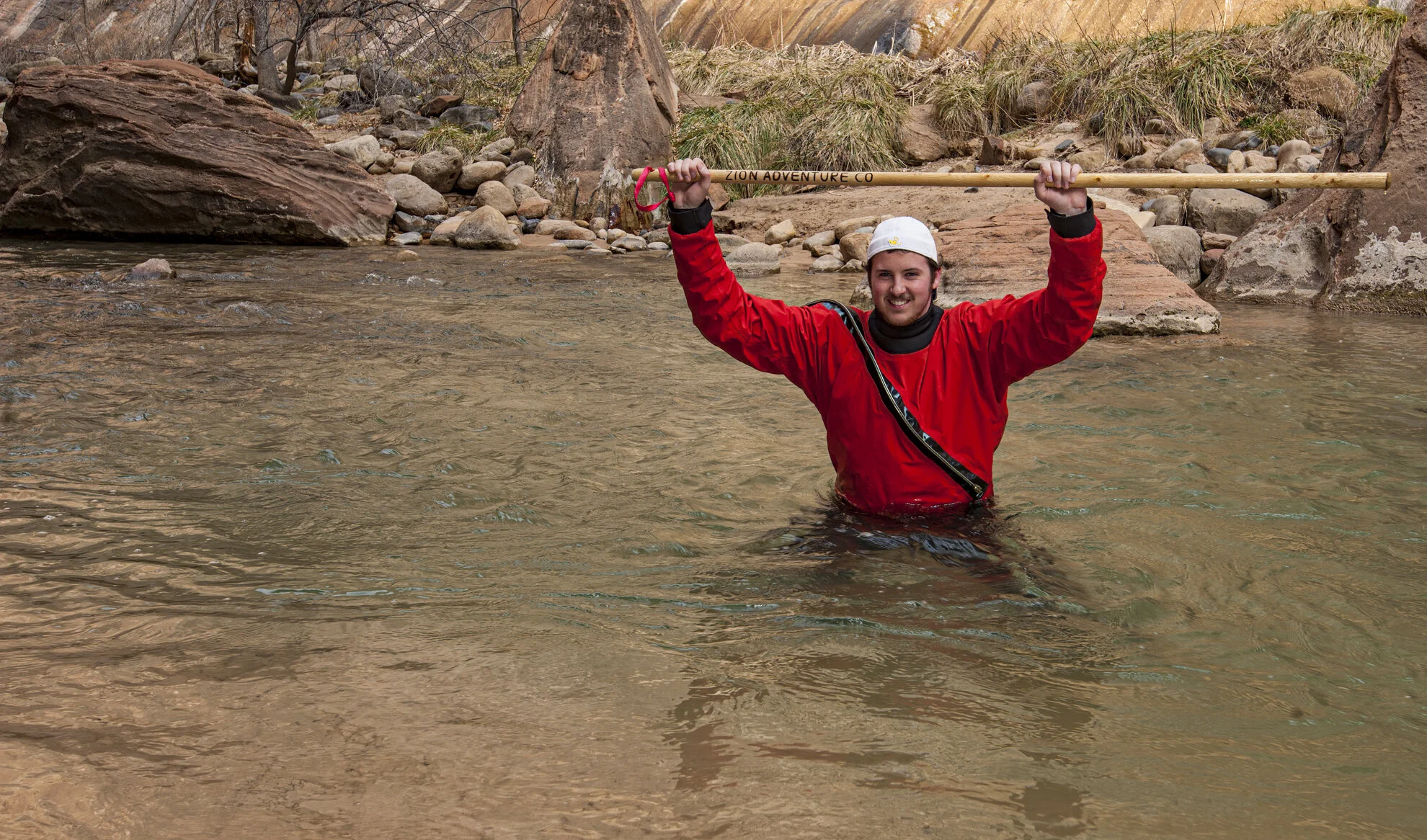
We had heard about Zion Canyon, as you went further up the Virgin River, that the canyon narrowed considerably and made for some amazing photography. So we went to a local adventure-outfitter company to get more information, and get geared up.
It turns out that you get a big walking stick, a dry suit, and rubber shoes, along with some good advice, warnings, and precautions!
This wasn’t my first time in Zion, but it was my first time in “winter”. I put winter in quotation marks because I hail from Northern Ontario and we normally get real winters! So besides being a little cooler than my previous visits, and lacking leaves on the deciduous trees, it was business as usual…. except perhaps for the temperature of the water — that was cold!
As we ventured farther and further into the canyon, the daylight was really played upon by the walls of the canyon.

We were not completely alone in the narrows. We met a few other intrepid explorers. They, like us, wondered what we, and they, had gotten ourselves into!
But the scenery, the rush of the river, and the sounds playing in the confines of the canyon conspired to make it all worthwhile!

The lighting changed at every bend, and turn in the river. It was so amazing to photograph.

The progress was slow-going. The river could be deep at times, and the current was always strong. We burned the shortened winter daylight hours quickly. Being caught after dark in this river was not an option and eventually we had to make the call to turn around so we could safely get back.
It was an adventure I will never forget!
The image below is my personal favourite from that day. It shows the adventure, the river, the narrows, and nicely sums up what was, for me at least, one awesome day with my son.

Iceland Never Disappoints

So how did this image happen? Allow me to tell you the story!
In early 2017, my friend’s son Noah had the urge to go on an adventure. I had recently quit my job and sold my business at the time. Robin asked me if I’d go with her son on a travel adventure because she couldn’t go, and didn’t want him travelling alone. Noah was 19 at the time.
So, with time and some money on my hands, I agreed.
Noah’s original plan was to tour around a bit in Central America. We did some initial research and then there was some bad headlines in the news about the stability of the region. So we decided we had better choose some other place.
Then, like a light bulb turning on, Iceland popped into our mind.
We learned all we could about Iceland. Booked some preliminary accommodations and flights on Iceland Air. What an adventure!
This photo was taken on Day 2 of our trip. As beautiful as this picture is, is doesn’t do justice to actually standing there, taking in this beautiful meadow with a glacier melt river running through it, with multiple waterfalls.
Our adventures entailed a flat tire, gale force winds, meandering through caves and crevices, crazy and narrow mountain roads, natural hot springs, and so much more!
If you fancy a trip to Iceland, you won’t be disappointed. However, be forewarned, it is not inexpensive!
I recently re-worked this photo to create a large print for a client. I am really looking forward to seeing it hang on the wall!
If you’d like to order a print, simple get in touch with me via the Contact Menu!
Tea Time on Lake Superior

Ice and Rocks Detail | (C) 2021 Thomas Detert
Over the years, I’ve seen many videos on YouTube of people undertaking an outdoor winter adventure. They hike somewhere breathtaking beautiful and enjoy a fire with a hot beverage.
Well, I live in Northern Ontario, and I figured, Hell, I can do that!. So I did, last Sunday.
You can watch our adventure in the video at the end of this blog post!
With the enlisted help and company of my friend Jake Cormier and his trusty furry companion Hudson, we embarked on a winter adventure.
We drove up to Lake Superior Provincial Park on a chilly Sunday morning. The air temperature was hovering around the -9 C (16 F) mark, with very little wind. We parked at the Orphan Lake trailhead and set out with two backpacks, with sandwiches, snacks, an ultra-light camper stove, some mugs and tea.

Overlooking Orphan Lake | Lake Superior Provincial Park | (C)2021 Thomas Detert
Once we reached the Orphan Lake Overlook, it was time to break out the sandwiches. Lunch sure does taste a whole lot better when you worked up and appetite and earned it! As we ate our lunch, the cloud cover broke up and left us with a spectacular view, with some of the weirdest lighting and cloud formation I had ever seen!

Weird light and clouds over Lake Superior. (C) 2021 Thomas Detert
The Orphan Lake Trail meanders its way down to the shoreline of Lake Superior. When we got there, it was time for tea. Jake scooped up a pot of ice cold Lake Superior water, and set it up to boil on his very small, ultra-light isobutane camp stove. Several minutes later, we were enjoying peppermint tea on the beach, on a cold winter’s day, on the shore of the largest freshwater lake in the world!
I was also most pleased with the snap I captured below. It is definitely one of my most favourite black and white photos I have ever taken!

Icy Patterns on a Sunny Day (C) 2021 Thomas Detert
As Jake put it, this day and adventure were one for the books.
If you’d like to share in our adventure, watch the video blog below!
Thomas Detert is a landscape photographer based out of St. Joseph Island, Ontario, Canada. You can view more of his work, or reach out to him at https://www.tomsview.ca.
Stories Behind the Photos
Learn why I took the photo. Where I took the photo. And sometimes I’ll even share how!
A short journal entry about the difficulty of taking a very nice flower photo.