How A New Drug Changed My Life
And Really Got Me Thinking…
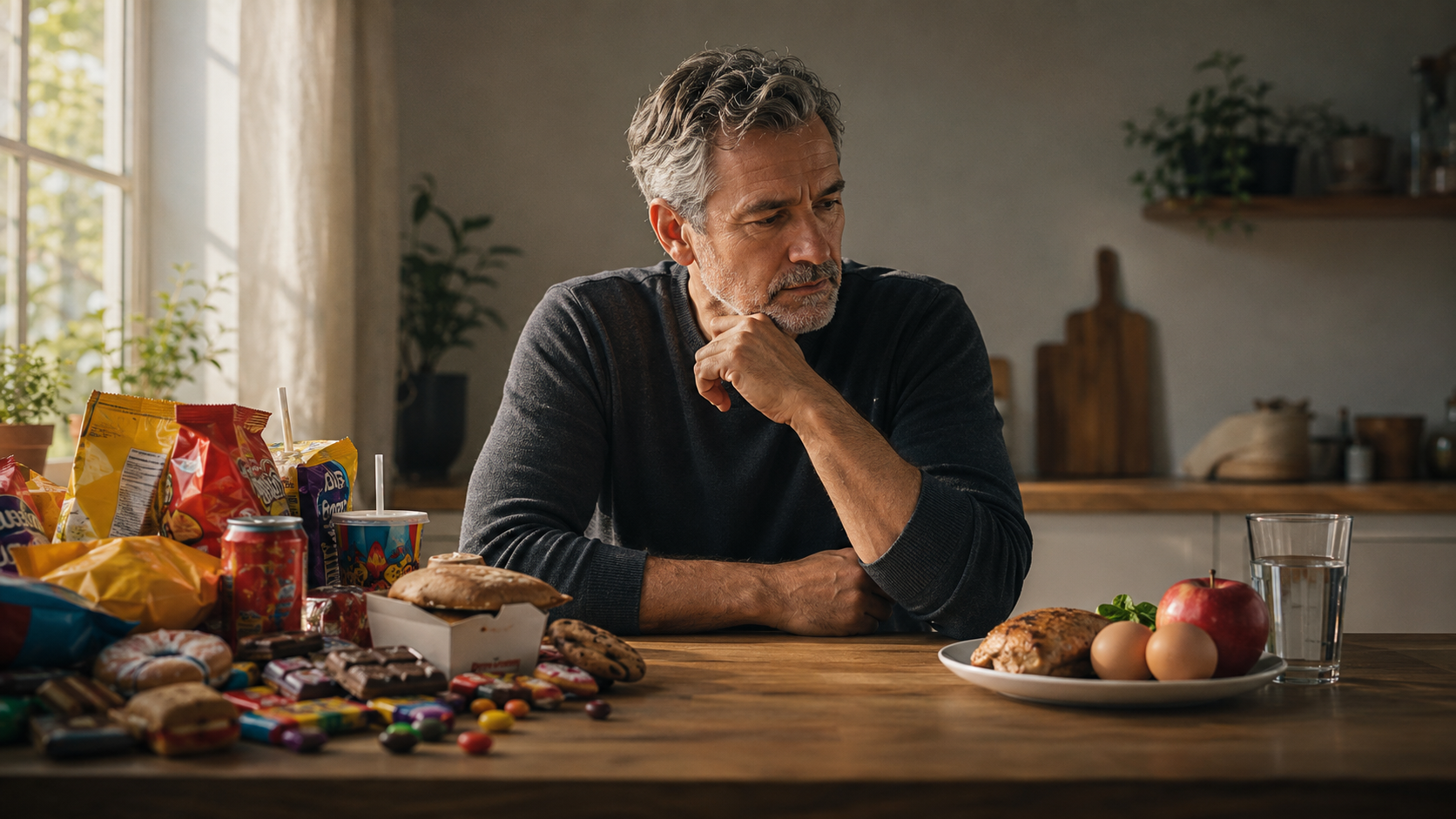
by Thomas Detert.
I recently started Zepbound.
I am not writing this as medical advice. I am not writing it as a weight-loss testimonial. And I am certainly not suggesting that any medication is magic.
But I am writing about something that happened after my first injection that I have not been able to stop thinking about.
Within hours, my relationship with food changed.
Not in some dramatic Hollywood way. I did not suddenly become a different person. I did not wake up with a six-pack and a refrigerator full of kale. I did not become morally superior or magically disciplined.
But something got quieter.
The urgency softened. The old background noise around food — the grazing, the craving, the subtle pull toward “just a little more” — was turned down.
And that got my attention.
Because when something changes that quickly, you start asking deeper questions. One of mine was this:
How much of what we call weakness is actually biology being pushed, prodded, overstimulated, and manipulated?
That question has stayed with me.
For years, like many people, I assumed that my relationship with food was mostly a matter of discipline. Eat less. Move more. Make better choices. Stop making excuses. Be stronger.
And yes, personal responsibility matters. It matters a lot.
But after experiencing what it felt like when the food noise dropped, I had to ask myself something uncomfortable:
What if I had been blaming myself for fighting a battle that had been engineered to be harder than it needed to be?
Food Is Not Just Food Anymore
We live in a world where food is everywhere.
It is cheap, convenient, colourful, salty, sweet, crunchy, creamy, portable, and available at almost any hour of the day. But more than that, a lot of modern processed food is designed to be extremely easy to overeat.
That is not an accident.
Food companies do not make more money when we feel satisfied and stop eating. They make more money when we keep buying, keep snacking, keep reaching, keep craving, and keep coming back.
I am not saying every processed food is poison. I am not saying every person who works in the food industry is evil. That would be too simplistic, and frankly, not very useful.
But I am saying the incentives are obvious.
If a company profits when I consume more, then my satiety is not necessarily their priority. My health is not their business model. My peace around food is not their quarterly target.
The goal is not always nourishment. Sometimes the goal is repeat consumption.
That means taste, texture, packaging, convenience, marketing, portion size, and emotional association all matter. The crunch matters. The sweetness matters. The salt matters. The mouthfeel matters. The way the food disappears quickly without making you feel truly full matters.
And if you have ever opened a bag of something intending to eat a small amount, only to look down a few minutes later and wonder where the rest of it went, you know exactly what I am talking about.
It is not always hunger.
Sometimes it is design.
Maybe We Are Not as Weak as We Think
This is the part that has made me more compassionate toward myself.
After that first Zepbound injection, I did not feel like a heroic man of iron will. I felt like a man who had been given a brief glimpse of what life feels like when one particular volume knob gets turned down.
And honestly, it was humbling.
Because it made me wonder how many people are walking around believing they are lazy, weak, undisciplined, broken, or morally flawed when in reality they are living inside an environment that has been designed to hijack some of the most primitive parts of the human brain.
Food is emotional. Food is biological. Food is social. Food is cultural. Food is memory, comfort, reward, habit, and chemistry.
So when powerful industries learn how to push those buttons better and better, maybe we should stop pretending this is only about willpower.
Willpower matters.
But willpower was never meant to be the only defence against an entire environment designed to overwhelm it.
That does not mean we are helpless. But it does mean we need to be honest.
After 50, the Game Changes
This topic hits differently for me now than it would have at 25, 35, or even 45.
Because after 50, the body changes.
That is not defeatist. It is reality.
The metabolism is different. Muscle is harder to maintain. Recovery takes longer. Testosterone is often lower than it once was. Sleep may not be as forgiving. Stress seems to leave a deeper footprint. The “get up and go” that used to appear automatically sometimes needs to be deliberately cultivated.
And the body becomes less tolerant of nonsense.
When I was younger, I could get away with more. Bad food, poor sleep, stress, inconsistency — I could often push through it. I might not have felt great, but I could still function.
Youth gives you a buffer. It lets you borrow from the future and pretend the bill will never arrive.
But after 50, the bill starts showing up.
Not all at once. Not necessarily in some dramatic crisis. But in subtle ways.
Less energy. More stiffness. More belly fat. Less resilience. Poorer sleep. More brain fog. Lower mood. Reduced confidence. Less desire to move. More temptation to numb out. More reliance on comfort.
And this is where the manipulation of food becomes especially important.
Because the very stage of life where we most need nourishment, strength, stability, protein, movement, sleep, and self-respect is the same stage where the modern food environment is still trying to sell us cheap stimulation.
It does not care that we are 50.
It does not care that our blood sugar matters. It does not care that our joints matter. It does not care that our testosterone, muscle mass, heart health, waistline, mood, and mental clarity matter.
It does not care that we want to feel alive for the next chapter.
It just wants us to keep consuming.
And if we are tired, stressed, lonely, discouraged, or quietly disappointed with where life has landed, we become even easier to reach.
That is not a character flaw.
That is a vulnerable human being living inside a very sophisticated environment.
Life After 50 Is Not the Leftover Portion
This is one of the reasons I think so much about life after 50.
Because life after 50 is not just about aging. It is about awakening.
It is about realizing that the old operating system may no longer work. The habits that got us here may not get us through the next chapter. The foods we tolerated may no longer serve us. The stress we normalized may now be costing us. The distractions we used to call entertainment may now be stealing the quiet we need to hear ourselves think.
And the dreams we postponed do not disappear just because we got older.
They wait.
Sometimes quietly. Sometimes painfully. Sometimes under layers of fatigue, regret, responsibility, and “maybe it’s too late.”
But I do not believe it is too late.
I believe life after 50 can become one of the most honest, powerful, and meaningful seasons of a person’s life — if we are willing to stop sleepwalking.
At this stage, health is not vanity. It is access.
Access to energy. Access to purpose. Access to confidence. Access to freedom. Access to joy.
And maybe that is why this topic matters so much to me. Because this is not just about losing weight or eating better. It is about asking whether the way we are living is actually supporting the person we still want to become.
This Goes Beyond Food
Food may be the easiest place to see it, but I do not think it stops there.
Once you start noticing how our biology can be manipulated through food, you begin to notice the same pattern elsewhere.
Our attention is manipulated. Our fear is manipulated. Our insecurity is manipulated. Our loneliness is manipulated. Our outrage is manipulated. Our desire to belong is manipulated. Our desire to be admired is manipulated.
And again, manipulation is not new.
The powerful have always tried to shape the behaviour of the many. Kings did it. Empires did it. Religions did it. Governments did it. Advertisers did it. Newspapers did it. Television did it.
What feels different now is the precision, the intimacy, and the saturation.
The manipulation follows us into our homes, our phones, our pockets, our bedrooms, our news feeds, our search results, our grocery carts, our streaming platforms, and our sense of identity.
It is no longer just a billboard on the side of the road.
It is the algorithm learning when you are tired. It is the ad that finds you when you are lonely. It is the influencer who makes you feel inadequate while selling you the solution. It is the celebrity who pretends to be authentic while promoting something they were paid to endorse.
It is the food product that lights up your senses while leaving your body undernourished.
It is the constant message that you are not enough yet — but you could be, if only you bought the next thing.
This is not paranoia.
This is pattern recognition.
The Danger of Outsourcing Your Thinking
One of the great risks of modern life is that we outsource too much of our thinking.
We follow influencers. We trust celebrities. We repeat headlines. We assume popularity equals credibility. We confuse confidence with wisdom. We mistake visibility for authority.
And I get it.
We are busy. We are tired. There is too much information. It is tempting to let someone else do the thinking for us.
But that is dangerous.
Because not everyone who has your attention has your best interest at heart.
Some people want to help you. Some people want to sell to you. Some people want to influence you. Some people want to keep you angry. Some people want to keep you afraid. Some people want to keep you dependent.
And some people want to keep you hungry — literally and metaphorically.
The more we outsource our discernment, the easier we are to lead.
That does not mean we should trust no one. It means we need to rebuild the habit of thinking for ourselves.
Research. Question. Compare sources. Pay attention to incentives. Ask who benefits. Ask what is being left out.
Ask whether the person speaking has actually lived what they are teaching. Ask whether they are trying to make you more free, or more dependent on them.
That one matters.
Personal Growth Is Not Optional Anymore
I used to think personal growth was something you pursued if you wanted a better life.
Now I think it is also a form of self-defence.
Not in an aggressive way. In a grounded way.
The more you know yourself, the harder you are to manipulate. The more emotionally regulated you are, the harder it is to control you through fear. The more secure you are, the harder it is to sell to your insecurity.
The more connected you are to your values, the harder it is to distract you with noise.
The more physically healthy you become, the harder it is to normalize feeling terrible.
The more you learn to pause, the harder it is to push you into impulsive decisions.
That is why personal development matters.
Not the cheesy version. Not the motivational poster version. Not the “wake up at 4 a.m. and dominate everyone” version.
I mean the real version.
The quiet version.
The version where you take responsibility for your life. The version where you become more aware of your habits, emotions, cravings, beliefs, fears, and patterns. The version where you stop sleepwalking through your own existence.
The version where you begin asking better questions.
Why do I want this?
Where did this belief come from?
Is this actually good for me?
Am I choosing this, or am I being nudged?
Does this make me more alive, or just more stimulated?
Does this serve the person I am trying to become?
That kind of growth is not fluffy.
It is freedom work.
The Hope
I do not want to end this in anger.
Anger has its place. It can wake us up. But if we stay there too long, it becomes just another form of manipulation.
I also do not want to end in cynicism. Cynicism feels intelligent for a while, but eventually it becomes lazy. It says, “Everything is corrupt, so why bother?”
I do not believe that.
I believe we bother because our lives still matter.
Our health matters. Our minds matter. Our families matter. Our communities matter. Our joy matters. Our ability to think clearly matters. Our ability to choose consciously matters.
And maybe that is where we begin.
Not by trying to overthrow the entire machine in one dramatic gesture. But by waking up in small, deliberate ways.
Read labels. Eat food that loves you back. Notice what makes you feel compulsive. Notice what makes you feel calm. Turn off the noise more often.
Spend time outside. Move your body. Question the people who profit from your insecurity.
Stop worshipping influencers just because they are popular. Stop assuming celebrities know more than you do about how to live. Do your own research. Make your own decisions. Build your own discernment.
And most importantly, learn to trust yourself again.
Because that may be the deepest damage manipulation does.
It does not just get us to buy the product. It gets us to doubt our own inner authority.
It makes us believe we are weak when we are overwhelmed. It makes us believe we are broken when we are overstimulated. It makes us believe we need someone else to tell us who to be, what to want, what to fear, what to eat, what to buy, and how to live.
But we can come back from that.
Maybe this is one of the gifts of life after 50.
We may not have the same metabolism we had at 25. We may not have the same testosterone, recovery, or automatic get up and go. We may not be able to abuse our bodies and bounce back as quickly as we once did.
But we do have something else.
We have perspective.
We have lived enough life to recognize patterns. We have made enough mistakes to know that not every craving deserves obedience. We have survived enough disappointment to know that numbness is not peace. We have chased enough things to know that stimulation is not the same as joy.
And maybe, if we are willing, we can become harder to manipulate.
Not bitter. Not paranoid. Not cynical.
Just awake.
Grounded.
Curious.
Self-respecting.
Willing to research.
Willing to question.
Willing to make our own decisions rather than blindly following influencers, celebrities, algorithms, headlines, or corporations that profit from our confusion.
That is where hope lives for me.
Not in pretending the world is not manipulative. Not in pretending aging is not real. Not in pretending discipline alone solves everything.
Hope lives in the decision to wake up and participate in our own lives again.
To eat in a way that supports the person we still want to become. To move because we are grateful we still can. To protect our attention because our remaining years matter. To question what we are being sold.
To choose growth over resignation.
To stop outsourcing our wisdom.
To remember that life after 50 is not the leftover portion.
It may be the most honest chapter yet.
My first Zepbound injection did not answer all of life’s questions.
But it gave me one powerful insight:
Sometimes the noise we think is ours was never really ours.
And once you realize that, you can start turning it down.
One meal. One walk. One honest question. One better decision. One reclaimed piece of yourself at a time.